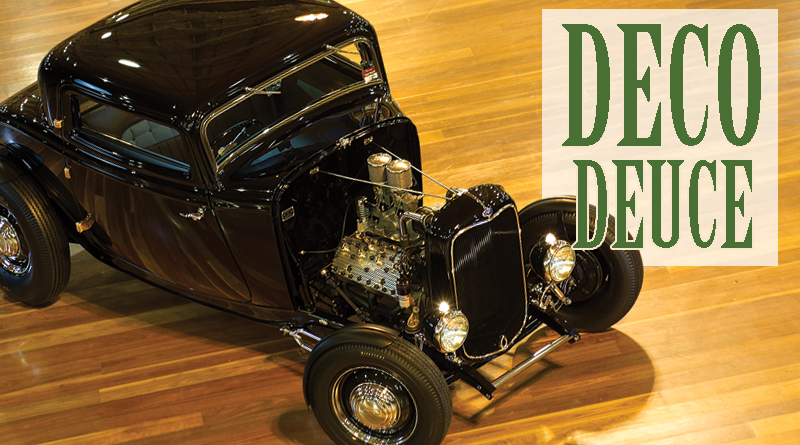
DECO DEUCE – JIM TZIVAKIS 1932 FORD 3W COUPE
“I had a vision of a hot rod built by a kid in 1957.”
That vision drove Jim Tzivakis to create the three-window coupe you see here. A labour of love that stretched close to seven years, the project tested his patience and his wallet, but a handful of like-minded rodders helped keep him on course when things threatened to stall.
Cars were always part of Jim’s life. His father worked on the GMH assembly line at Dandenong from the EH era through to mid-’80s Commodores, occasionally bringing home surplus parts that became Jim’s toys.
“That’s how I got into cars,” he says.
Street machines were his first passion. On a minimum wage, he modified an HZ Holden with a performance carby, extractors and a home respray. But everything changed when a bright red ’34 Ford coupe flashed across his TV screen in a ZZ Top video clip.
“I remember thinking, ‘Wow, that’s cool — I want one.’”
Model kits followed while the real thing remained out of reach. He studied cars at shows, drawn to traditional rods and the elegance of Art Deco styling.
“I grew up around old cars and antique furniture. Modern stuff never interested me. I wanted a period-style car.”
Jim chose 1957 as his reference point — when overhead-valve V8s were taking over and style was king. A ’32 Ford was the logical base. He admired the deuce roadster but preferred the tougher look and practicality of a three-window coupe, especially in Melbourne’s unpredictable weather.
Legality limited the amount of chop he could apply, but he remained determined to capture the right stance. Steel was his first preference, yet the cost and additional modifications made it unrealistic. A local fibreglass company was unwilling to customise a body to suit his ideas, which included a steel firewall, external hinges and a swing-out windscreen.
Through HAMB contacts he was directed to Melbourne rodder Victor O’Neill.
“I told him what I wanted and he said, ‘Yep, we can do that.’”
The modified body was delivered to Hell Bent Hot Rod Engineering, where John “Wombat” Clay and Spider carried out further fabrication. The floor incorporates laminated steel plate for strength without bulky bracing, and custom-cast brass hinges were reproduced from an original set.
“I wanted people to second-guess whether it was steel or ’glass.”
For full registration at the time, Jim needed original ’32 chassis rails. After searching locally, he sourced rails and a crossmember from overseas. A dropped Model A axle from Gary Paige handled front suspension duties, keeping the build traditional without resorting to expensive reproduction parts.
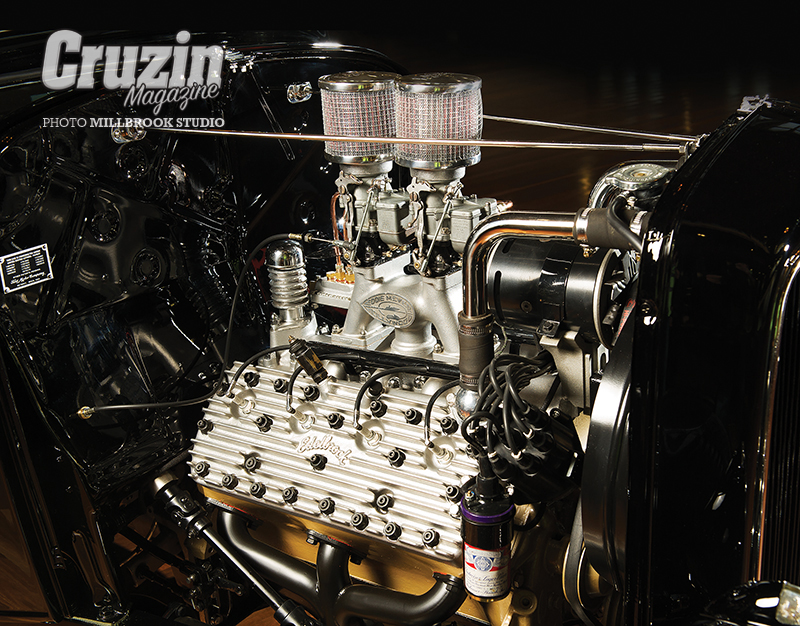
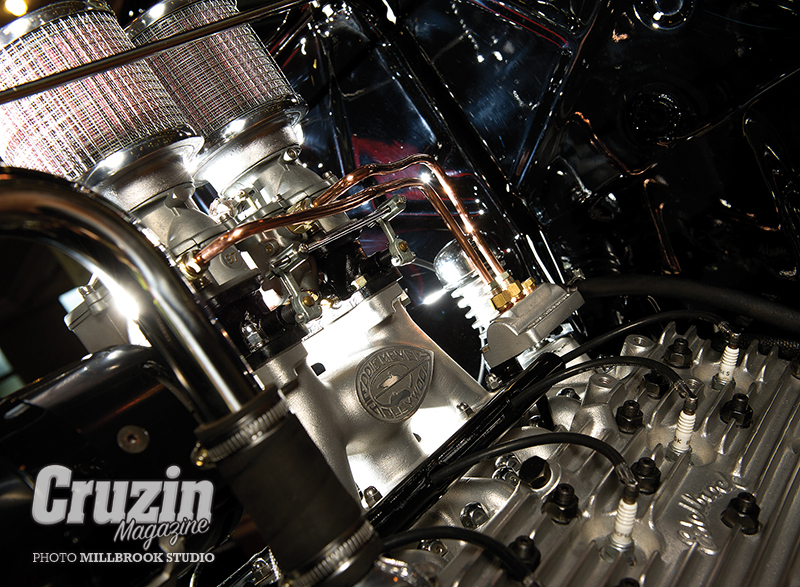
Engine choice proved more complicated. A Buick Nailhead was considered but firewall clearance ruled it out. A flathead Ford suited both the era and the look. An imported engine turned into an expensive lesson after failing pressure testing, so a sound block was rebuilt locally by Rod Rainford at Advance Engine Dynamics with Ross pistons, polished stock rods and crank, high-compression heads and Pertronix ignition. A Toyota five-speed backs the flatty to a Centura diff — practical upgrades largely hidden from view.
Chassis construction was entrusted to Ben Thomas of Rancho Deluxe.
“His work was like art,” Jim says.
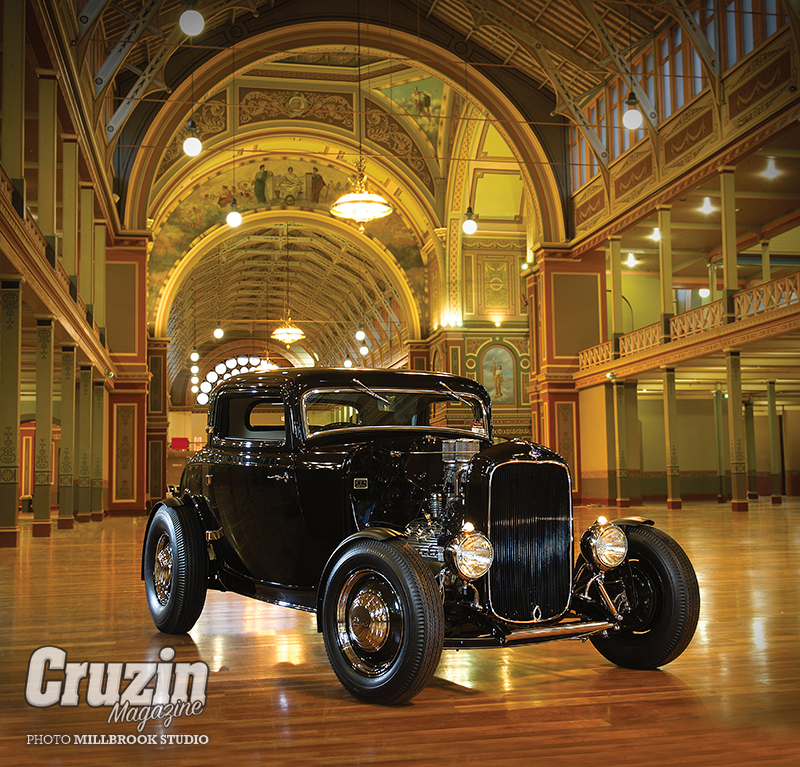
With the rolling chassis complete, attention turned to colour. Jim had long considered deep maroon, but a last-minute decision saw the coupe finished black on black.
“I know it’s been done to death, but there’s a reason for that.”
Billy Tsiokas of Smart-Finish applied Valspar straight black tinter sealed in Glasurit clear, left uncut to retain a subtle period-style texture.
Genuine ’40 Ford 16-inch wheels wrapped in blackwall Firestones complete the exterior, capped with script nut covers and ribbed beauty rings.
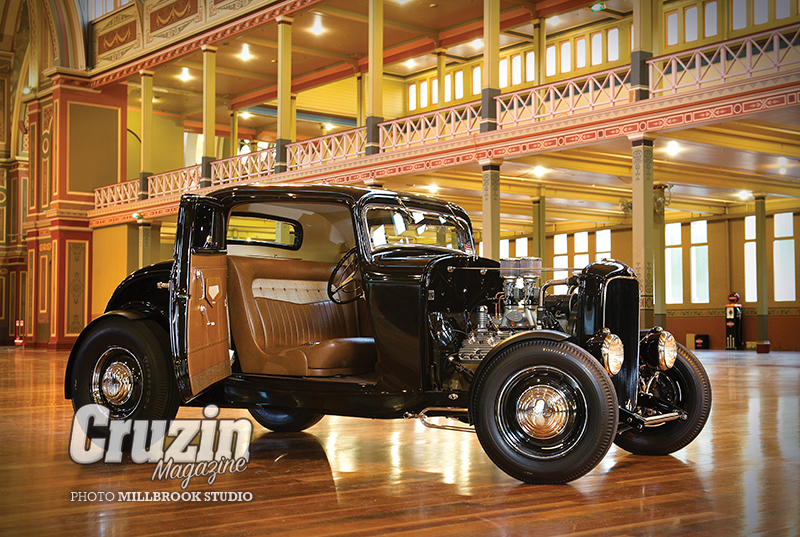
Inside, Adrian Morgan of Kool Trim helped refine the interior concept. Saddle-coloured Ford XY Falcon material covers the seats and door trims, complemented by Porsche headlining and period Mercedes carpet. Insert detailing adds a mid-’50s flavour without overpowering the cabin.
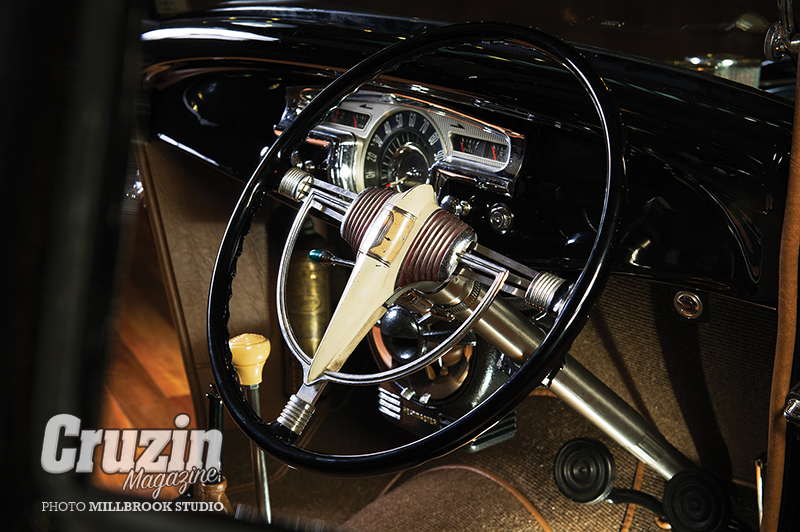
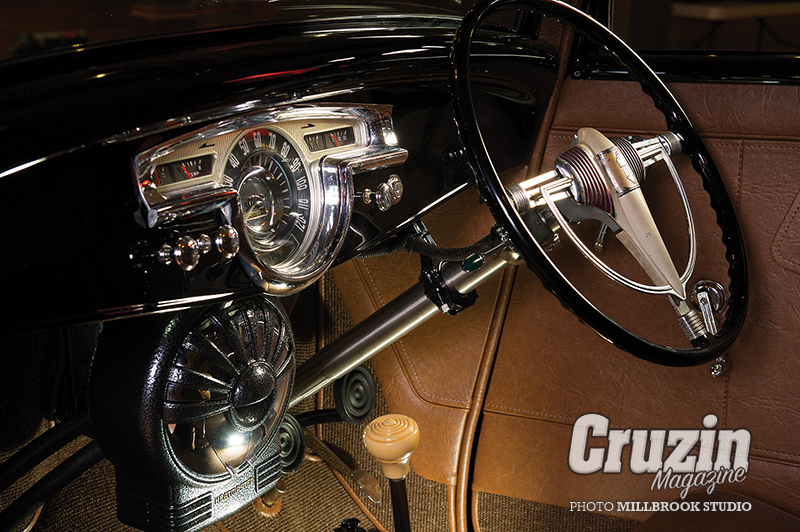
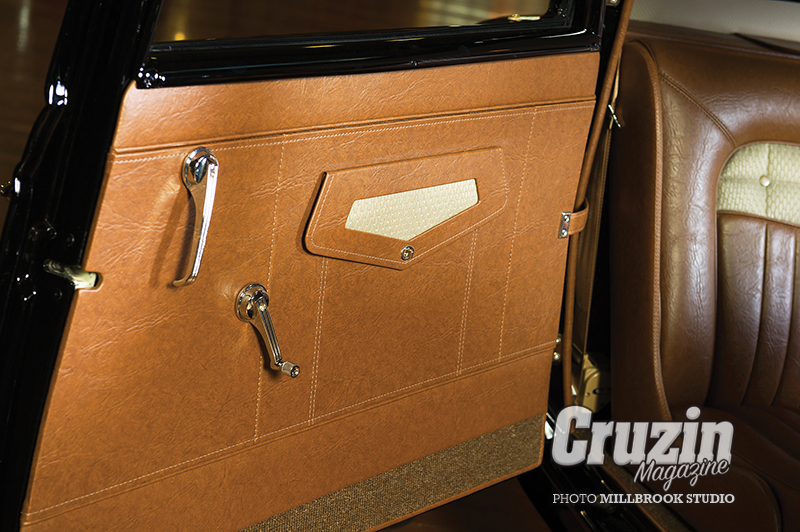
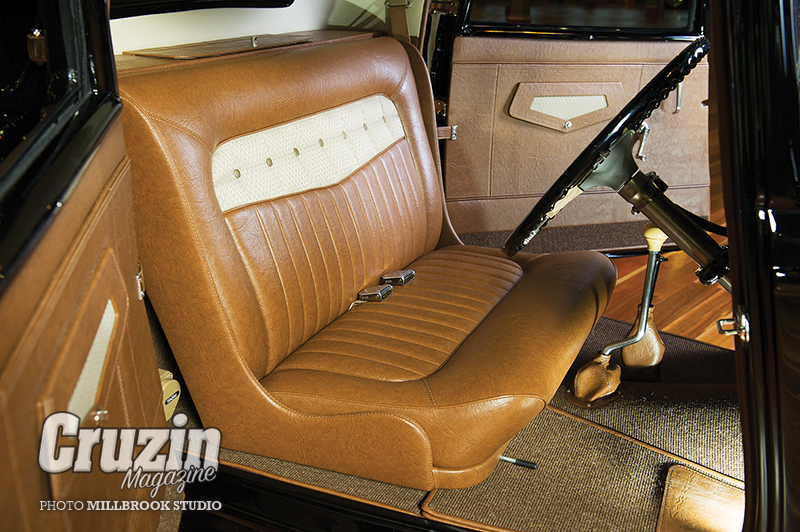
Jim’s attention to detail is most evident in the components he sourced over years of swap meets and online searches. A 1941 Pontiac steering wheel tops a custom column. A ’55 Oldsmobile gauge cluster and a 1938 Dodge heater blend seamlessly with period knobs, handles and lighting. Outside, ’41 Pontiac tail-lights, bus indicators and Guide headlights reinforce the cohesive theme.
“I didn’t want to just buy a catalogue of parts and bolt them on.”
The Melbourne Hot Rod Show became the target debut. Short on time and money, Jim drove the coupe to the event on a permit, narrowly avoiding disaster when an air cleaner came loose on the freeway and had to be retrieved.
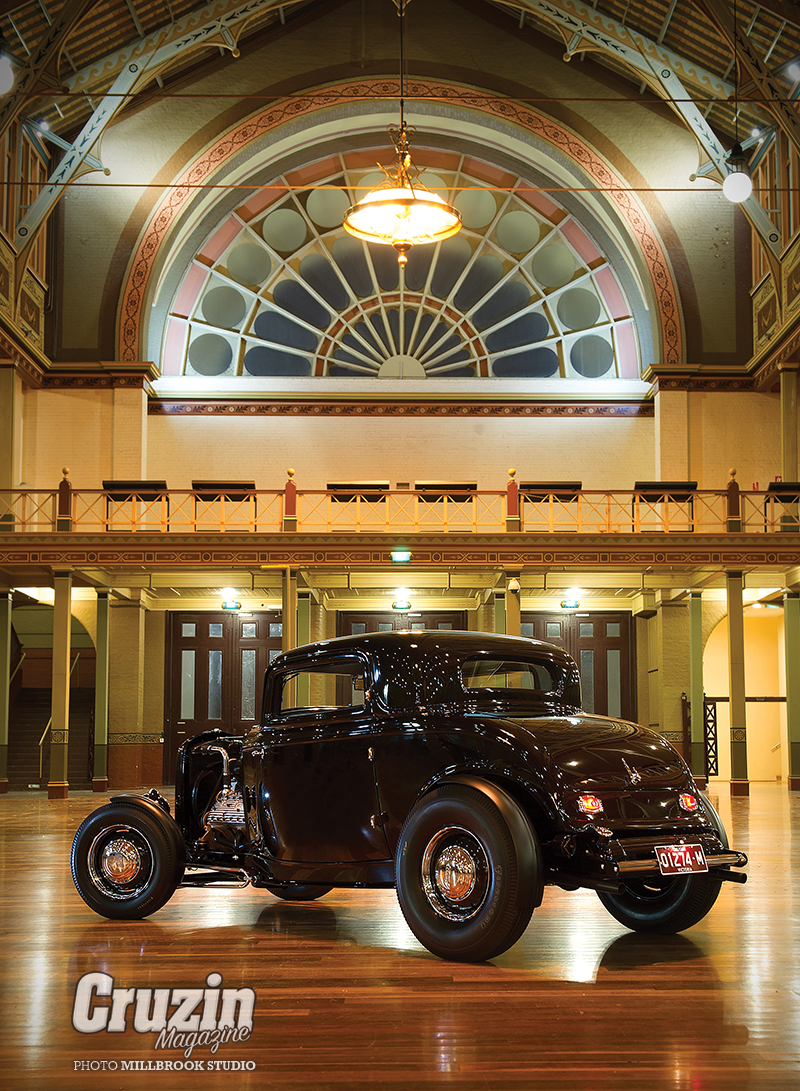
Despite the stress, the Deco Deuce debuted successfully, earning third place in a competitive class. But the most satisfying moment came from a simple question at the show.
“Someone asked if it was steel or ’glass. He couldn’t tell. That’s when I knew I’d achieved what I set out to do.”